

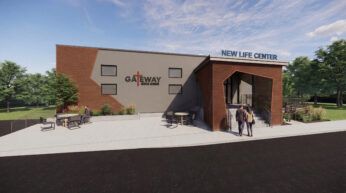
CCD Architects is pleased to partner with Gateway Rescue Mission, a Christian ministry that provides life changing hope through programs to deliver food, shelter, counseling and discipleship to the men, women and children in the Jackson area. CCD’s design services included developing a long-range master plan for its Gallatin Street facilities, to bring them together into one cohesive campus to best serve its residents and staff. As part of this master plan, CCD provided architectural and interior design for the renovation of an empty two-story 24,000 SF warehouse building on the southern end of its campus. Phase 1 will consist of new parking lots and landscaping, the exterior renovation of the building with a new image, and the built out of the upper level, for classrooms, offices, dormitories, and a Chapel. This phase will almost double the size of their addiction recovery program and allow them to house program residents in a separate building from overnight guests. A future phase will build out the lower level into transitional apartments with a living areas and kitchen, recreation room, and a multipurpose room. We are excited to be a part of the Gateway ministry and work alongside dedicated individuals helping the “least of these” in such a worthwhile mission.
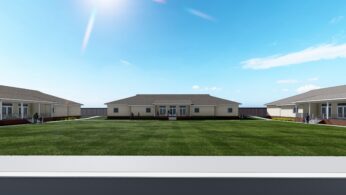
CCD Architects partnered with Canopy Children’s Solutions to develop a long-range master plan for a one-of-a-kind psychiatric residential treatment facility (PRTF) for children and adolescents ages 6 to 17 with severe emotional and/or behavioral challenges, at its CARES Center’s Bagley Campus in Jackson, Mississippi. Phase 1 was completed in 2009 and consisted of a school, play field, trail, and 3 residential treatment cottages for 30 children. Phase 2 is currently under construction and continues to follow the master plan by creating 5 additional treatment cottages with 50 single-occupancy bedrooms, which will increase Canopy CARES Center’s total campus capacity to 80 beds. The project goal is to create a viable PRTF Campus that will improve the quality of life and mental health of the children and adolescents in need of these special services and to safely provide enhanced care and treatment to the adolescents who have essentially “slipped through the cracks” because of their high acuity level. We are excited to be a part of the Canopy team and work alongside such wonderful and dedicated healthcare professionals and share in such a worthwhile mission.
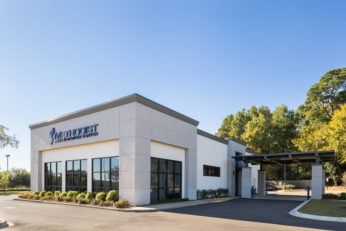
CCD Architects continued its long-standing relationship with the Methodist Rehabilitation Center (MRC) in developing an Outpatient Therapy Center in Clinton, Mississippi, for their physical, occupational, speech and neurological therapy patients. CCD faced a unique challenge when MRC obtained an existing former Pizza Hut and instructed to turn it into a first-class health care facility meeting MRC’s strict standards. Designing various scenarios, it was determined that the best course of action was to remove the upper part of the building structure, leaving the concrete floor slab, and design a new facility from the ground up. the 3,600 SF “new” facility utilizes all the accessibility and healthcare standards required by MRC, and follows the Comprehensive Interior Design Standards created by CCD. The facility contains a large open “gym like” clinic area, multiple Exam, Speech and Orthopedic Exam rooms, and a kitchen to re-create an at-home active daily living rehab area.

CCD is excited to see The Exchange Church relocated to their new space in the Rankin Square Shopping Center in Pearl, MS. CCD partnered with the Exchange over 10 years ago, and journeyed alongside them to develop a long-range master plan to phase and transform a former bowling alley and retail store into a dynamic new home for its growing congregation. The expansive 35,000-square-foot facility is three times the size of the church’s former location, allowing for greater ministry opportunities to serve its members and the surrounding community. Designed to foster connection, worship, and engagement, the church features a 400-seat Worship Center, 100-seat Student – Multi-Use Theater and a large student Gathering – Gym Space, 2 Kids theaters and multiple dedicated classroom spaces for Kids and Pre-school programs, a 125-seat Adult – Multi-Purpose Room, along with a large open Commons, coffee area, and Administrative office suite. We are thankful to be a part of The Exchange’s exciting new chapter in their journey.
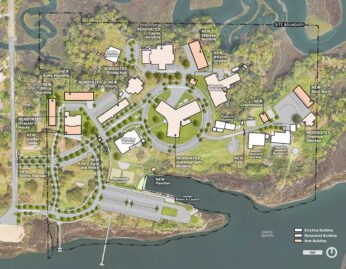
The University of Mississippi’s Gulf Coast Research Laboratory (GCRL), located in Ocean Springs, is Mississippi’s designated marine laboratory and a premier center for coastal and marine research. Dedicated to scientific discovery, education, and the responsible stewardship of natural resources, GCRL advances research in coastal ecology, sustainable fisheries, aquaculture, and marine technology.
CCD Architects, in collaboration with Page, developed a comprehensive 10-year master plan for the Halstead and Cedar Point campuses. The plan establishes a clear long-term vision and strategic framework to guide investment, renewal, growth, and resiliency across both sites.
Centered on strengthening the laboratory’s research and education mission, the master plan addresses the modernization of existing facilities, the integration of new buildings, enhancement of open spaces, expanded large-vessel storage, improved vehicular circulation, and resilient design strategies responsive to the floodplain and storm surge conditions inherent to the coastal setting.
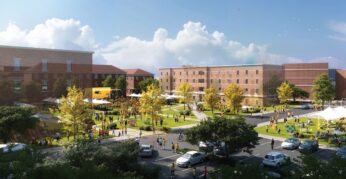
CCD Architects developed a comprehensive master plan for the University of Southern Mississippi encompassing both the Hattiesburg and Gulf Park campuses. The plan provides a flexible framework for future growth, addressing academic and student life priorities, facilities, circulation, open space, and infrastructure while allowing the University to respond to opportunities as they arise. Rather than prescribing a single linear sequence for implementation, the plan establishes multiple paths for advancing projects based on priorities, funding, and opportunity. Early-win strategies identify improvements that can be implemented with minimal investment, allowing the University to begin making meaningful progress immediately while positioning the campuses for long-term growth.
CCD led a nationally recognized consultant team, including Page (Stantec) (planning) and Neel-Schaffer (civil and mobility).

A new chapel is planned at Pinleake’s Reservoir Campus to provide a more appropriately scaled and intimate setting for smaller gatherings, such as weddings and funerals, where the larger worship center and venue spaces may feel too expansive. Designed to accommodate up to 300 guests, the chapel will also include dedicated spaces for wedding parties and family gatherings before events. Its traditional architectural style is intended to create a warm and welcoming atmosphere, featuring stained glass, stone, board and batten siding, exposed trusses, steeply pitched roofs, and vaulted ceilings. Construction is set to begin this year.

In 2010 CCD teamed with Pinelake to repurpose a car dealership into a new satellite campus for the church. The campus has seen significant growth over the past decade. We are now working together to expand the campus and renovate parts of the existing church. The expansion includes a 900-seat worship center, equipping classrooms, offices, and commons. The existing worship center will be repurposed as a theater, activities room, and equipping classroom. A new commons is carved into the existing plan to seamlessly connect the new spaces with existing spaces.
The building’s exterior uses stone, stucco, metal, glass, and wood to form a contemporary composition that is appropriate for the young congregation’s worship style and interests. As part of the project, the existing building’s exterior will be renovated to compliment with the expansion.

CCD was engaged to design a memorial tower for the Gibbs-Green Memorial Plaza at Jackson State University. Gibbs-Green Plaza is named in memory of Phillip Lafayette Gibbs, 21, a junior pre-law major and James Earl Green, 17, a senior at nearby Jim Hill High School. They were killed on May 14, 1970 as Jackson police opened fire on a crowd of students at Jackson State University. The memorial tower within Gibbs Green Plaza would elevate that role by introducing a clear, legible landmark—something that is instantly recognizable on arrival and meaningful over time. The tower is conceived not simply as a vertical element, but as a symbol of remembrance. Plaques on the interior of the tower would celebrate the lives of Gibbs and Green and explain the events surrounding their deaths. Positioned to define key sightlines and pathways, the tower would provide orientation across campus, acting as a “you are here” marker for visitors and a familiar beacon for students and alumni.

In Clinton, Copiah Bank acquired a former branch vacated by a competing institution and transformed it into a modern, welcoming banking facility. Working closely with the client, we revitalized the dated structure into a contemporary environment that reflects Copiah Bank’s brand and commitment to customer service.
The exterior design builds upon architectural standards established through our previous collaborations, featuring a sophisticated palette of white painted brick, dark bronze accents, and cypress timbers. Inside, the design emphasizes a modern banking experience, with a sleek layout and durable materials complemented by a fresh mix of colors and textures that create an inviting and efficient space for both customers and staff.